Worldwide shipping. Duties calculated at checkout.
“Some things are covered not to conceal, but to honour.”
Restraint is not the absence of luxury. It is luxury's most advanced form. Every decision Raavi makes — in a garment, in a photograph, on a screen — is tested against one question: does this need to be here? What survives that question is the brand.
Modest dressing is not a limitation to design around. It is the discipline that produces the best design — the same way a sonnet's constraints produce better lines than a blank page. And heritage is not something to display. It is something to let a customer discover slowly, the way she would discover it in a well-kept house — never announced at the door.
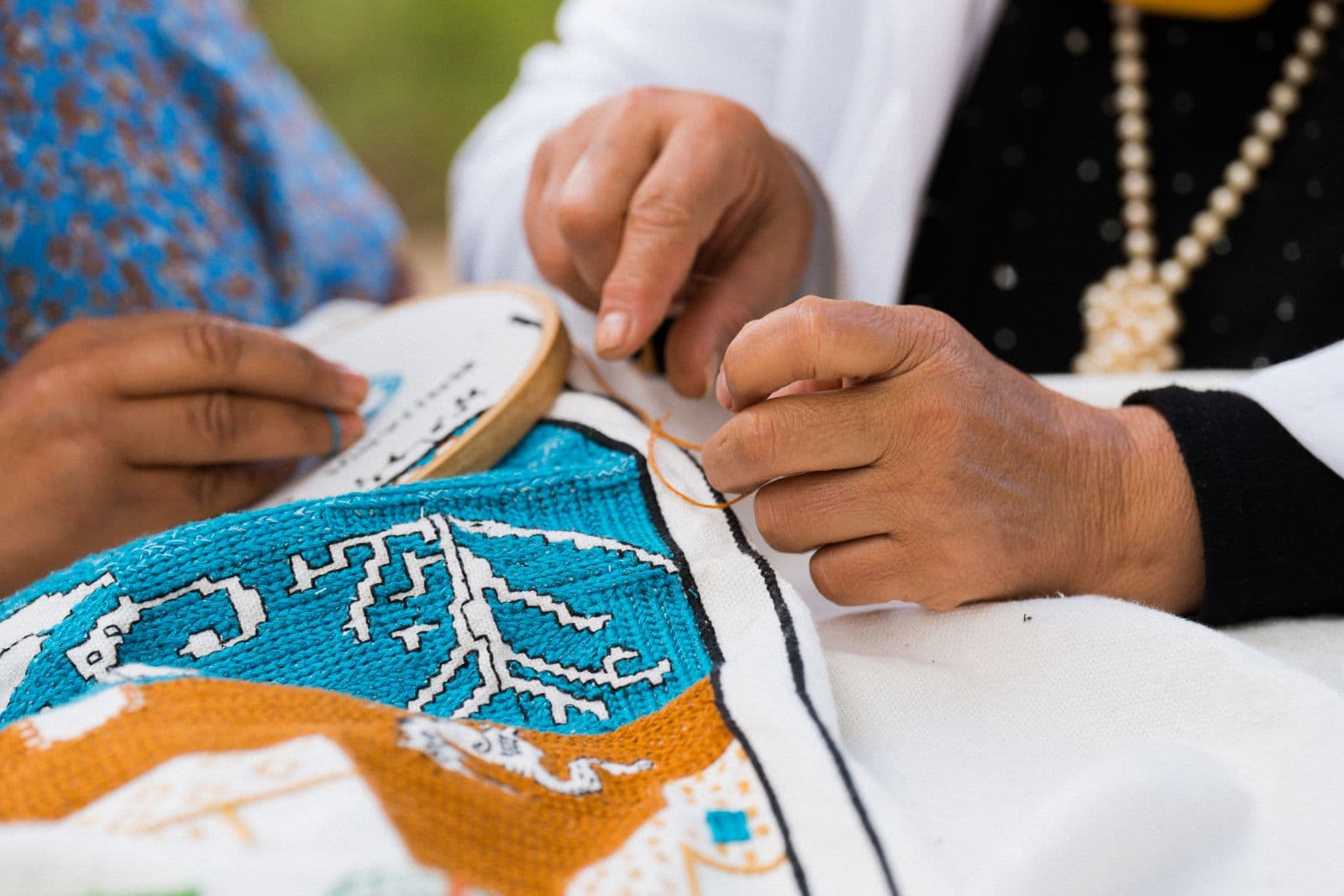
Every piece begins with a technique, not a trend. Karigari — literally, the artisan's work — is the discipline of spending a working life inside one method until it can be done with total certainty. It is refined by one pair of hands over decades, not adjusted for a season.
An apprenticeship in hand embroidery typically runs three to five years before an artisan is trusted with a piece bound for sale — first learning tension, then rhythm, then finally speed, always in that order, never reversed. A single Raavi piece can carry anywhere from six to ninety hours of hand work, depending on the technique: tonal thread work sits at the shorter end: a full zardozi bodice, worked by several hands over several weeks, at the longer. Every piece is inspected by hand before it ships — not as a formality, but because a machine cannot yet tell the difference between deliberate irregularity and a mistake, and hand-work always carries a little of the former.

Raavi is named for the river that runs through the heart of Punjab — the same water that has shaped the region's craft geography for centuries. It is not a decoration on the brand. It is where the brand's name actually comes from.
The Raavi has run through this region since long before any of the techniques carried in this collection had names — tila, zardozi, mukaish, phulkari all grew up along its banks, passed from hand to hand in villages the river connects rather than divides. The mark that appears quietly on our swing tags and packaging — a single calligraphic line that reads as both a river's bend and a stroke of Nastaliq script — is the closest thing this brand has to a signature beyond its name. It appears in exactly two places, deliberately, so it never stops meaning something when you find it.
We hold three collections, thirty-six pieces, on purpose. A karigar who works one technique for a decade cannot also produce at the pace a larger catalogue would demand — so we chose the technique.
A tonal thread border, left to be the only decoration on an otherwise plain khaddar kurta, is a considered decision — not a shortcut. The empty space around a garment is as considered as the garment.
We will never manufacture urgency — no countdown timers, no fake low-stock warnings. What you see in a photograph is what arrives, colour-accurate, every time.